


St. Michael's Church
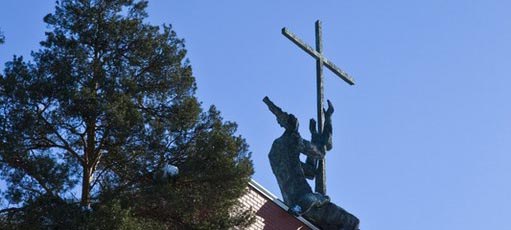
The red brick St. Michael's church was designed by architects, Käpy and Simo Paavilainen. The church was build on the same location as the temporary Kontula church of Heikki and Kaija Sirén from the 1960s, which was demolished in 1986.
The church is dominated by delicate pink. The basic ship-like shape of the building is repeated in the roof lamp, which imitates the votive ship seen in old churches, and in the communion set designed by the Hungarian sculptor, Zoltan Popovits, who lives in Finland. The cloth hanging in front of the altar, the antependium, repeats the same form. The candle holders, altar crucifix and procession cross are also the handicraft of Popovits.
On the altar in St. Michael's Church there is a triptych by the artist and writer, Hannu Väisänen, called Helluntain ihme – fragmentteja uskosta (Miracle of Whitsun – fragments of faith), from 1988. The altar itself is a green marble rock which resembles the tombstones used as altars in the catacombs of the Early Christian era. This is a reference to Byzantine iconography, where the manger of the child Jesus is prophetically shaped like a funerary coffin. The pulpit and baptism table, also marble rocks, remind us of the Early Christian era as well. On the left wall of the church are empty panels representing the Tablets of the Law Moses received from God.
The church textiles were designed by textile artist, Maija Lavonen. Their material is Thai raw silk. Lavonen designed relief-like, embossed patterns in the altar cloth. The red altar cloth has five roses symbolising the wounds of Christ, the white one has olive tree branches, the green one a wreath depicting the continuation of life and the violet one the crown of thorns and two crosses symbolising the suffering of Christ. The black altar cloth used on Good Friday has an embossed embroidered “INRI”, the initials of the words “Jesus of Nazareth, King of the Jews”. The letters were nailed above Jesus when he was hanging on the cross. In the other church textiles, Lavonen mostly used the cross symbol.
The organ, which originates from the Kangasala organ builder in 1991, has 30 stops. They are particularly suited for playing classic Northern European organ music. The bell tower is a separate long, narrow building in the church courtyard. Six bells of different sizes can play tunes composed for the different ceremonies of the ecclesiastical year.
The building also has facilities for the needs of diverse parish activities, from a room with a fireplace to a practice room for the gospel ensemble. Next to the church is a play area for the youngest family members, with a view to the church itself.
On the roof is the five metre high Ristin tie (Via Crucis), the work of sculptor, Kari Juva. The character in flowing clothes is the leader of the heavenly army, archangel Michael, after whom the church is named. Many also see in the sculpture a man leaning on the cross.
St. Michael's Church is used by the Mikael parish.
Celebrations at the church
Members of the church can organise a baptism, a wedding or a funeral free of charge in the church.
St. Michael's Church seats 300 and the parish meeting hall 250. There are 150 seats at the tables in the parish meeting hall. The kitchen and the 150-piece set of tableware are at the disposal of the party organiser. The church also has smaller party facilities.


